Appelbaum Reflects on Tough 2020, Looks Forward to ’21
NYTHA president’s wish list includes vaccinations, health care for trainers.
Like virtually everyone else in the New York metropolitan area, Joe Appelbaum was delighted to bid farewell to 2020.
Yet for Appelbaum, who was re-elected last month to a second term as president of the New York Thoroughbred Horsemen’s Association, even amidst the catastrophe of the COVID-19 pandemic, there were some special moments that will stay with him for some time to come.
“COVID dominated everything in 2020, but what I hope to remember is how all of us in New York responded,” Appelbaum said. “We were at the epicenter of it early on and our team and (the New York Racing Association) and our whole racing community really had to band together to get a handle on things in the backstretch. That kind of communal work is something you will never forget.”
Some 10 months since the first day a New York racetrack was closed due to the pandemic, coronavirus remains an omnipresent threat that has refused to release its choking grip on the world.
Having four Belmont Park backstretch workers quarantined and one hospitalized at the moment reflects how the battle against COVID-19 has yet to be won and is far from over. But at the same time, there are some reassuring signs.
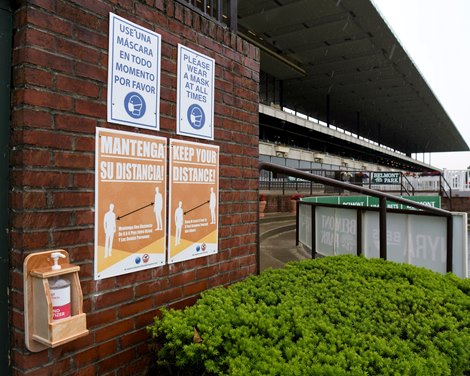
At the height of the pandemic there were about 40 cases of coronavirus at Belmont Park. Yet about four months later, there were no cases in the barn area or racetrack during the Saratoga Race Course meet, and now, with just a handful of the 550 people who live at Belmont Park and the 1,200 that work there on a daily basis diagnosed with the virus, it is extremely revealing. It shows how the struggle to contain the virus has intensified and how teamwork has paved the way to considerable success since the initial days of the crisis.
“We’ve been working very hard. It’s not that we didn’t have cases, we did,” said Appelbaum, who is involved in racing, breeding, and sales through his Off The Hook operation. “But we handled them in a professional way with the guidance of medical people and that in the end has helped us. It allowed us to get back to racing fairly quickly and has sustained us throughout the crisis, leaving us in a fairly strong spot going forward.”
Though NYRA tracks were shuttered for 80 days, once Belmont Park opened for racing June 3 there were no other closings due to coronavirus for the remainder of the year. Though there was the tragedy of Martin Zapata passing away in April, the number of backstretch workers diagnosed with COVID-19 was remarkably low for most of the year as Appelbaum, NYTHA executive director Will Alempijevic, and the horsemen worked effectively with NYRA, its safety stewards and groups such as the Backstretch Employee Service Team and Race Track Chaplaincy.
“It’s a community back there and it’s hard for all of us. You see the denial that goes on across the country but when people you know or work with are hospitalized or sadly pass away it’s a reminder that the disease is here and it’s as bad as anyone says it is,” Appelbaum said. “The lessons to learn are preparation, organization, making sure your systems work. They don’t sound like fancy lessons but they are the things that you have to do. We talk about the individuals in racing who win a training title or win the Travers, and that’s a normal narrative, but the fact is what gets you through crises like this and keeps the big wheel turning is to make sure your systems are in place, that everything works and everyone works together.”
Martin Panza, NYRA’s senior vice president of racing operations, was thankful for the cooperation from NYTHA in navigating a year with unprecedented problems.
“(2020) was a trying year and we appreciate everything Joe and NYTHA are doing,” Panza said. “Purses are at a record level and it’s because we are all working together.”
Like every other business, racing suffered during the pandemic. Fans have not been allowed to attend the races at NYRA tracks since the sport resumed in June and most likely that will not change until Belmont Park re-opens in the spring—at the earliest. The casino at Aqueduct Racetrack, which funds about 38% of NYRA’s purses, was closed for about six months, creating an additional strain. But a combination of factors, including conservative budgeting the last few years by NYRA and purse reductions, most noticeably among graded stakes, enabled racing to continue on a daily basis even as professional sports struggled with cancellations due to the pandemic.
Since racing shifted from Saratoga to Belmont Park in late summer, NYRA has yet to offer a stakes with a purse above $250,000.
“A lot of people depend on earnings from the track to keep their business going and that made it incredibly challenging. It was no different than what a lot of small businesses have experienced. Some people think we are immune to these things at the racetrack, but we are not. Owning a restaurant now is a lot like training a mid-sized stable. You have payroll to meet, feed bills to pay, you have to buy hay, pay insurance and so on. So when your income stops coming in, it makes it difficult,” Appelbaum said. “I think NYRA did the right thing with purses. The stakes purses are not where most of our guys make a living. That’s where some of them make a living, but it was something we had to do. You could either cut purses or cut days and we worked with NYRA to try to find the right balance, and I think that worked out rather well. It was the right business thing to do with the purses because without those little guys you can’t fill your races.”
Perhaps the best sign of NYRA’s popularity and the importance of the teamwork that kept racing afloat during the year was that even with the loss of 43 race days total all-sources handle for 2020 was $1.8 billion. The average daily handle of $11.5 million represented a 19% increase over 2019.
“What we all know now, but we didn’t realize enough before, was the way our fans appreciated the quality of our signal,” said Appelbaum, who played college football during his undergraduate days at Yale University. “The quality of the racing and the production value NYRA puts into its television shows proved to be highly beneficial in this environment.”
To help combat the virus, the native New Yorker would like to see the government make vaccines available to horsemen and backstretch sooner rather than later.
“Job one in 2021 is to get everyone on the backside vaccinated, and the front side people, too, as soon as possible,” he said. “I think we’re going to make some progress over the next month but it’s hard to tell. The vaccine rollout has been less than advertised, so it’s been frustrating.”
Beginning Jan. 6, NYRA made space available at Belmont Park for Northwell Health to administer COVID-19 vaccinations to those eligible for them under New York State guidelines. This week, vaccine eligibility in New York was expanded to include all outpatient/ambulatory front-line, high-risk health care workers who provide direct in-person patient care, as well as all public health care workers who provide direct in-person care, including those who conduct COVID-19 tests and handle lab specimens. In addition, all front-line, high-risk public health workers who have direct contact with patients, including individuals who administer COVID-19 tests, handle COVID-19 lab specimens, and those directly engaged in COVID-19 vaccinations are also eligible to receive the vaccine.
Panza said he is hopeful racetrack workers will become eligible for the vaccine in the next few weeks.
Looking ahead to the new year, Appelbaum said he’s cautiously optimistic about 2021. One of his main resolutions for the new year is getting out the word about the merits of racing in New York.
“It’s important to let people know how good the racing scenario is in New York compared to most other venues. People get scared coming up here. They worry about workmen’s comp or labor costs or their ability to compete against the very best trainers, horses, and jockeys. But, quite frankly, we are coming out of this crisis in a stronger position than any other racetrack in the country,” Appelbaum said. “Our purses are stronger, we have full programs and are not in danger of being shut constantly. Our signal survives on its own, even though it is helped by (video lottery terminals) money, it is not reliant on VLT money and that’s probably a better scenario for horsemen than they understand. That’s critically important.”
Appelbaum also pointed to a 40% reduction in workers’ compensation costs over the last four years as another major selling point for New York racing.
“The workmen’s comp situation in New York has changed incredibly since four or five years ago. It’s so much better that we are receiving inquiries from other states about what we are doing,” Appelbaum said. “The rates that are charged for workmen’s comp are down 40% in four years. In addition, the jockeys fund has instituted programs that are very trainer-friendly. While we do charge $1.60 a day per stall for workmen’s comp, your first 12 stalls are free. If you have 40 horses you pay for only 28. Also, now through the end of the winter meet there is a $300 credit per start that can be used toward workmen’s comp for the rest of the year. That adds up to a considerable amount of money.”
He said NYTHA also intends to work with the state legislature to enact health care for horsemen.
“We need the legislature to pass a law and the governor to sign it and we’re working with our people in Albany,” he added about the chances of getting health care for trainers. “It was introduced last year but wasn’t enacted. We’re hoping to get it over the finish line this year. Even though it will use a little bit of purse money to pay for trainer’s health insurance, it would set some minimums for trainers to run here that will pay for itself by getting guys to run more frequently. COVID has exposed cracks in our system for people who do not have health care and we want to make sure people are covered. We see it as a positive to the business in that we are investing money to get people to run here more often.”
A major change at NYRA tracks in the new year is the expansion of the restrictions on the race-day use of Lasix. Last year, NYRA banned Lasix in 2-year-old races and in 2021 it will also be prohibited in all of its stakes.
Appelbaum said he has not heard many complaints from horsemen about the Lasix ban, and believes restricting the use of clenbuterol is a more important step for properly regulating the sport. Though not a steroid, clenbuterol can be used as decongestant and bronchodilator to help breathing yet it can also promote an increase of muscle mass, just like steroids.
“Lasix is one of the issues that is talked about by boards and the media that most horseman don’t comment on. We’ve had almost no feedback on the changes. It’s one of those issues that can be a huge talking point by people who sit on various boards but not a huge issue to the people out there caring for horses every day,” Appelbaum said. “I think the number one issue is clenbuterol and a number of states, particularly in the Mid-Atlantic region, are moving very aggressively to restrict its use. I think that’s something we want taken care of on a broad level as quickly as possible.”
Appelbaum believes clenbuterol reflects how some medications that are allowed can pose a bigger threat to the sport than supposed “wonder” drugs that can transform a horse’s performance overnight.
“I would say while it’s less romantic of a notion, the misuse of known and approved modalities is probably a larger problem than the use of unknown treatments or mystery treatments,” he said. “Although that doesn’t play as well when you are writing a mystery novel, the facts on the ground are that most of the things that we want to see people stop doing are things that are readily available to them. Clenbuterol is a perfectly good treatment modality that has a purpose, however, the purpose can’t be to increase the horse’s performance.”
